02 — The Story
Hands pressed together, roofs pitched like prayer
Gassho means hands joined in prayer: the shape of the roofs, pitched at sixty degrees so that meters of Hokuriku snow slide off instead of crushing the house. The frames hold together without a single nail, bound with rope and maintained across generations. Under those roofs families once farmed silkworms in the attic warmth and, in this particular valley, quietly manufactured gunpowder for a samurai clan that preferred the operation unfindable.
The remoteness that once hid the gunpowder now keeps the valley quiet. Shirakawa-go, one valley south, absorbs the tour buses: the district's traffic runs to two million visitors a year, and the vast majority stop there. Ainokura (twenty gassho roofs) and Suganuma (nine) receive the small remainder.
03 — When to Go
December to February, under deep snow
The roofs were pitched to shed exactly this snow, and December through February buries the villages past the first-floor windows. Green season is lovely in a milder way, with rice terraces and near-empty lanes.
Jan◎
Feb◎
Mar△
Apr○
May○
Jun○
Jul○
Aug○
Sep○
Oct○
Nov△
Dec◎
◎ deep snow ○ green season (rice terraces, quiet lanes) △ between states. Day visitors leave around 17:00; the villages after dark belong to the handful of overnight guests.
The Peak Moment
Stepping out of your farmhouse after dinner into falling snow, the other nineteen roofs dark against the hillside, woodsmoke in the air: a landscape with no century attached.
The Light-Up Nights (2026)
| Suganuma | “Snow Lantern” illumination | Feb 7–8 |
| Ainokura | village light-up | Feb 21–22 |
| Hours | dusk until 20:00 · cars need no reservation (¥1,000 parking) | ~17:30–20:00 |
Two weekends only, re-announced each season. The dates above are the 2026 program, checked August 2026. Overnight guests see the villages after dark on any night they stay.
04 — Getting There
A bullet train, then a bus named after the prize
Lv.4
Nothing about the route is hard, but the World Heritage Bus runs five times a day and the inns hold perhaps a dozen rooms between them, so winter dates need booking well ahead.
Tokyo Station
Hokuriku Shinkansen “Hakutaka” · ~2 h 50 m · ¥14,050
reserved seat · covered by JR Pass
Shin-Takaoka Station (baggage can be sent ahead; travel light from here)
World Heritage Bus · ~1 h 10 m · ¥1,100
5 a day · round-trip pass ¥3,500 (2 days) · runs every day, even in snow
Ainokura (twenty thatched roofs; three of them are inns)
Other starts: from Kanazawa, the Tsurugi shinkansen reaches Shin-Takaoka in ~15 min; some Kanazawa–Shirakawa-go highway buses stop near Suganuma. Suganuma itself is 20 min further down the same World Heritage Bus line (¥1,300 from Takaoka).
Trip Receipt per person · from Tokyo · 1 night
Shinkansen, round trip¥28,100
World Heritage Bus, 2-day pass¥3,500
Getting there~¥31,600
Farmhouse: 1 night, dinner & breakfast¥9,800–15,500
Museums, snacks & small change~¥2,500
The whole scene~¥44,000–50,000
This is the Budget badge itemized: quite possibly the cheapest World Heritage night in Japan. Checked August 2026.
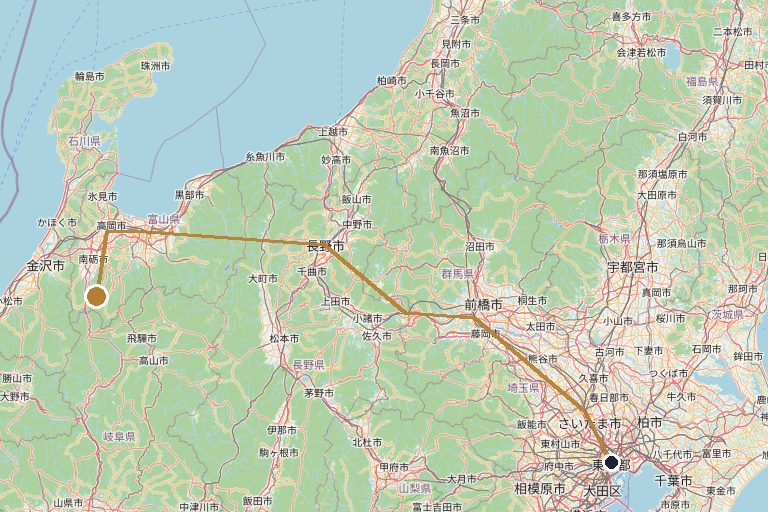 Tokyo
Ainokura
Map © OpenStreetMap contributors · tap to open the route in Google Maps
Tokyo
Ainokura
Map © OpenStreetMap contributors · tap to open the route in Google Maps
JR PassMostly covered. The shinkansen both ways; only the ¥1,100 bus is on you. This scene is nearly free for pass holders.
CarNot needed. The bus runs daily year-round. If you do drive: the roads are plowed, the preservation fee is ¥1,000, and winter tires are non-negotiable.
LuggageA baggage-forwarding counter serves the bus stops. Send the suitcase, walk in with a night bag. The lanes are snow and stone.
CashCash only, effectively. The inns, the fee box, the little shops. No ATM in either village. Withdraw in Takaoka.
The Honest Part
Ainokura's entire accommodation comes to three farmhouse inns with a handful of rooms each, and one of them takes a single group per day. For winter, book months ahead is meant literally. If the inns are full, a day trip still beats skipping it, but day visitors are asked to leave by five, before the hours the overnight guests get the village to themselves.
05 — Where to Stay
Three farmhouse inns, all gassho houses
Disclosure: some booking links below may earn us a commission at no extra cost to you. Inns are chosen on merit, never for commission. These three book mostly by phone and official sites; the real thing takes a little effort.
Price guide, per person with dinner & breakfast: roughly ¥9,800–15,500 (+¥500 heating fee Nov–May at some houses). Irori-hearth dinners and thick futons, under roof beams that have held for centuries.
Chōyomon
$$
Ainokura · gassho farmhouse · 3 rooms, max 6 guests
A working gassho house with an English website and a hearth that has not gone cold in living memory. From ¥15,000 with two meals: mountain vegetables and river fish, served at the hearth.
English site availablePhone or OTA
Goyomon
$$
Ainokura · gassho farmhouse · village center
Mid-village, three tatami rooms, ¥9,800–10,500 with two meals: the lowest rate of the three houses. Book by phone (10:00–20:00) or via JTB.
English: minimal; keep it simplePhone · JTB
Yusuke
$$$
Ainokura · gassho farmhouse · one group per day
The whole house, one booking: irori dinner, local dishes, and a night where the only other guests are the ones you brought. For couples or families who want the village entirely to themselves after dark.
English: inquiry form1 group / day; book far ahead
07 — Commissioned Review
Our reviewer's honest take
Disclosure: This review was commissioned by SPECTRIP, the publisher of HYAKKEI. The writer traveled independently (their visit date is shown below) and was paid for their writing, not their opinion.
Writer: recruiting nowSeasoned Japan travelers only, with a farmhouse night hereVisit date shown on publish
VerdictOne line. Did the scene earn its number? Answered after the visit.
The momentThe specific minute it moved them, and what the light was doing when it happened.
Who shouldn't comeThe honest anti-recommendation. Every scene has one.
Expert Panel Score3 travel writers who have stayed here · recruiting now
Impact★★★★★—
Onlyness★★★★★—
Worth the Journey★★★★★—
Stay & Food★★★★★—
Return Intent★★★★★—
Average of 3 writers with published travel work, each of whom has spent a night here. Panelists are paid for their judgment, never for a number.