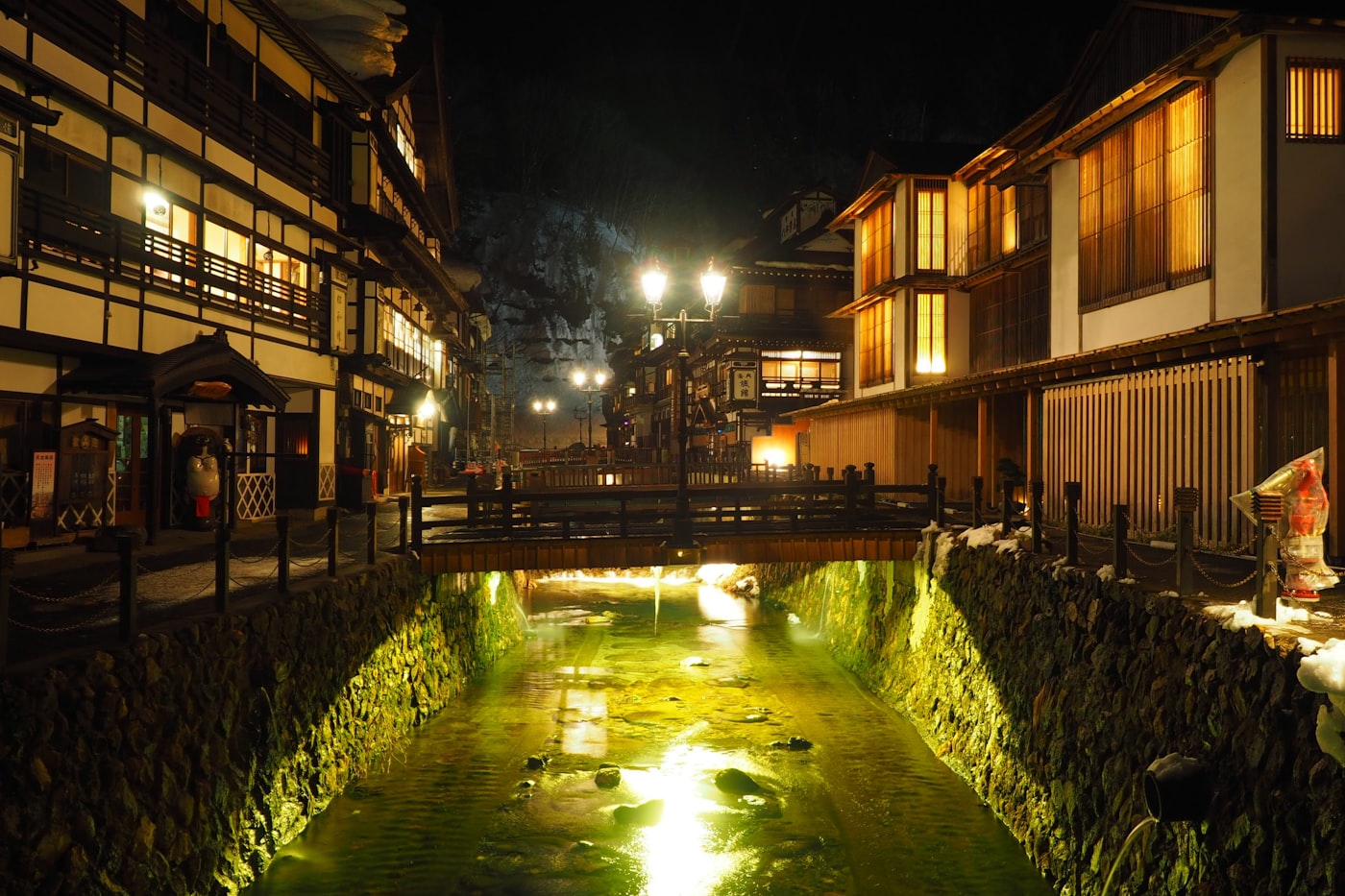
At 5 p.m. in January, the gas lamps come on one by one, and a river of warm light runs between four-story wooden inns half-buried in snow. For the next thirty minutes, the town looks like a Japan that only ever existed in films. Most people plan the whole trip around this half hour. It's worth it.
Access Lv.3Budget ~¥65–85kBest: Dec – FebAfter duskOnsen · Heritage
Ginzan means silver mine. Long before this narrow Yamagata valley became the most photographed onsen street in Japan, it was a rough town of miners working seams first opened in the 1600s. The silver eventually ran out, but the hot springs stayed. In the 1920s, after a massive flood destroyed much of the old town, the innkeepers rebuilt all at once, in the fashionable style of their moment: tall wooden ryokan with balconies and painted plaster, pressed shoulder to shoulder along a single river.
Most Japanese towns rebuilt themselves again and again through the twentieth century. Ginzan was too remote to bother with, so its 1920s streetscape survived almost intact. The valley is also too narrow for cars; they stop at the village entrance, and everyone walks in from there.
We made it Scene No.1 because it's the clearest example of what this site is for. The town is at its best on a snowy winter night, but being there for that window takes some planning. The rest of this page walks you through the details.
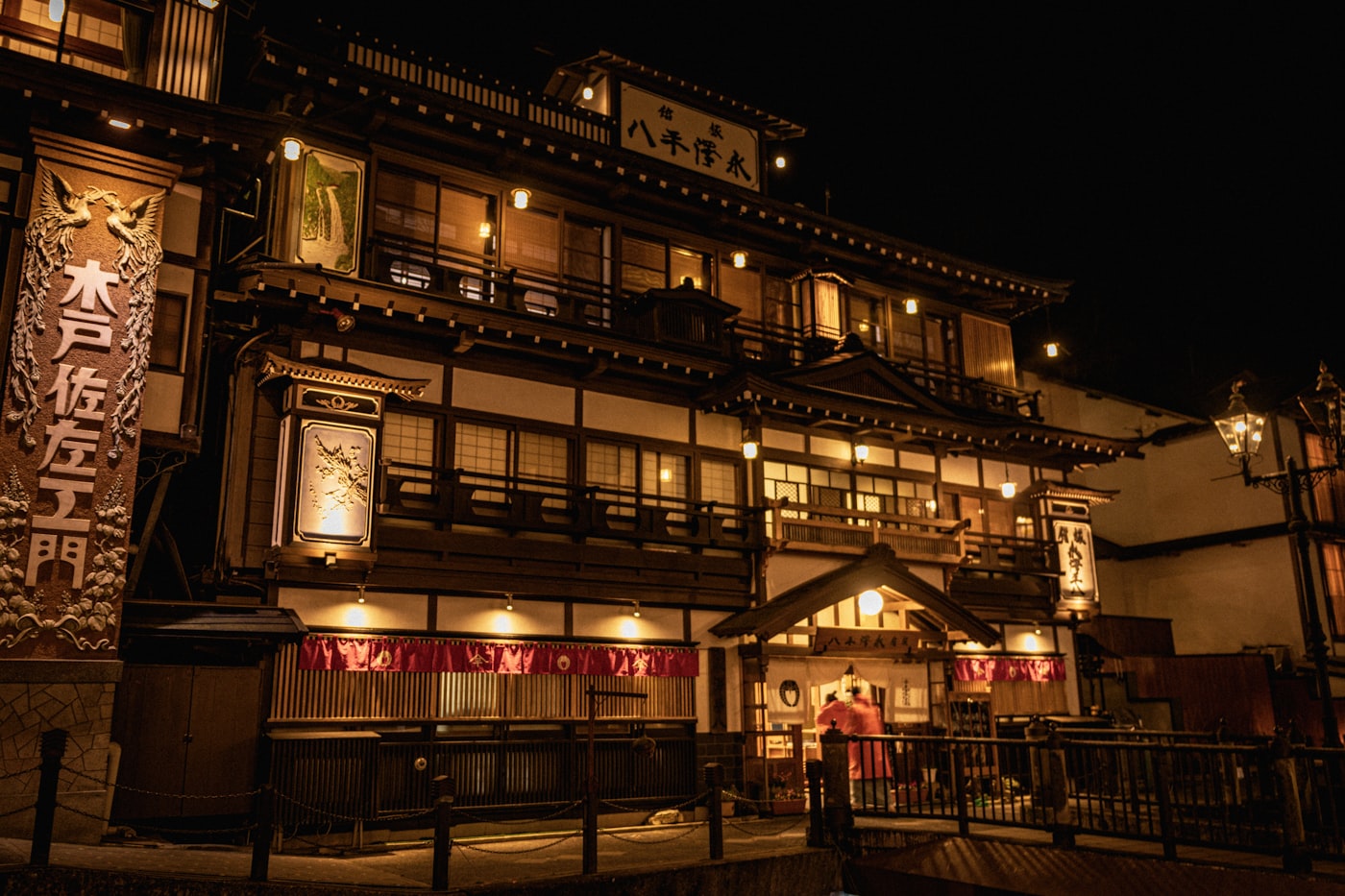
A Taisho-era inn after the lamps come on. Photo by Sylvia Xu on Unsplash
03 — When to Go
December to February, after dark
Ginzan is pleasant in every season. But the version on the postcards, with the lamps burning in falling snow, only happens from December to February, and only after dusk.
Jan◎
Feb◎
Mar△
Apr△
May○
Jun○
Jul○
Aug○
Sep○
Oct○
Nov△
Dec◎
◎ the scene at full strength ○ lovely, different town △ between seasons. Avoid the New Year holidays (fully booked, and the biggest day-trip crowds of the year).
The Peak Moment
During or just after snowfall, the thirty minutes after the gas lamps are lit. Check sunset time and work backwards.
When the Lamps Come On
Dec – Jan
the earliest, and the best
~4:30 p.m.
Feb – Mar
dusk pulls back fast
~5:00–6:00 p.m.
Apr – Sep
long evenings
~6:00–7:00 p.m.
Oct – Nov
closing in on winter again
~4:30–5:15 p.m.
The lamps follow dusk, not a fixed schedule, and stay lit until around 9 p.m. The 4:30 p.m. deep-winter time is confirmed, and the other seasons are estimates from local sunset. Treat them as a planning guide.
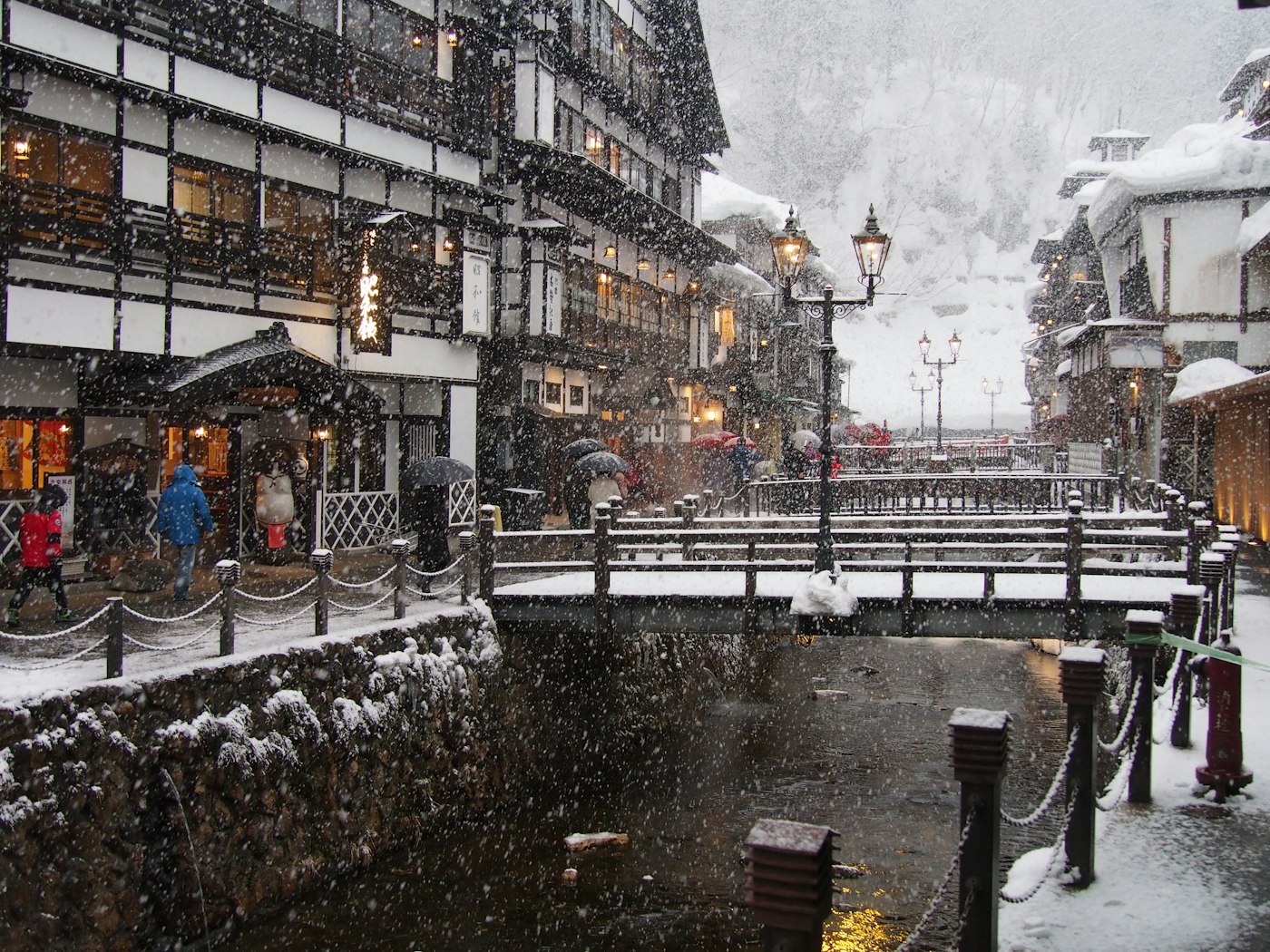
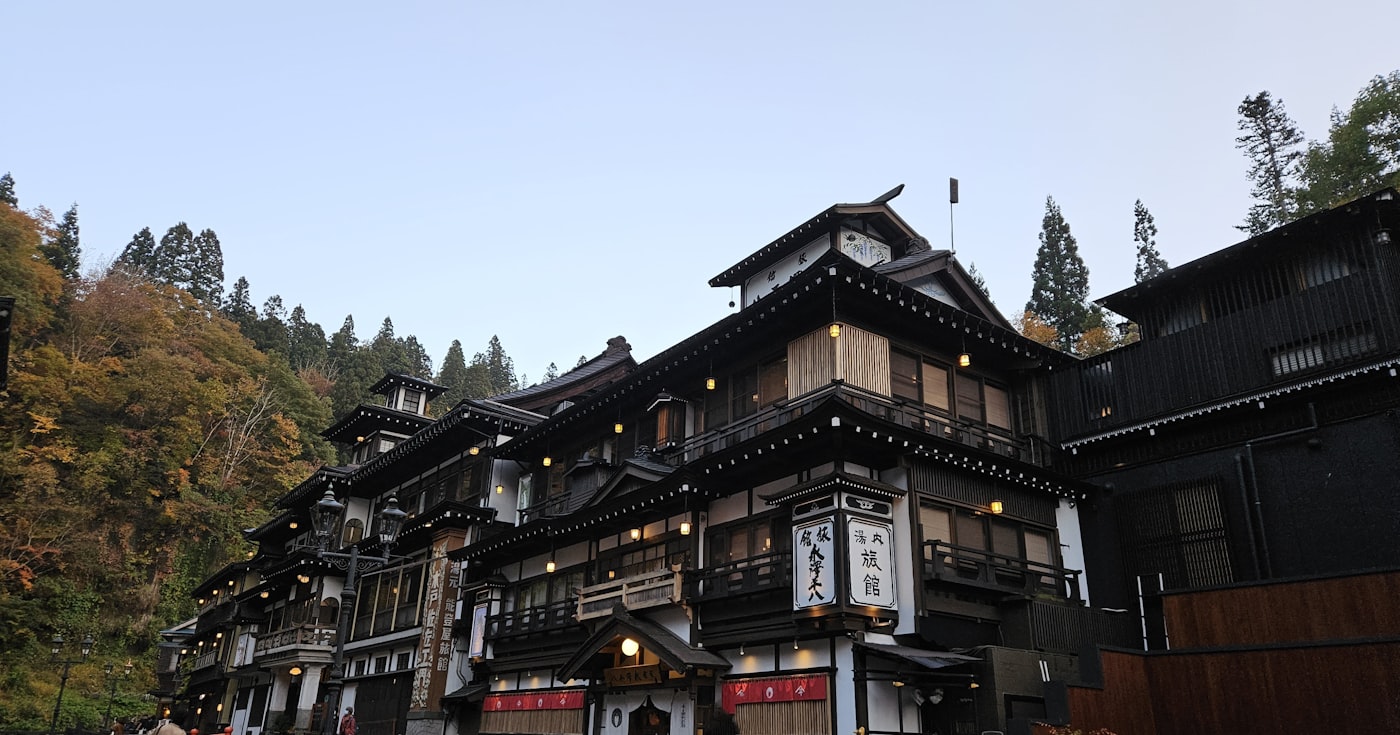
Snowfall at midday: the town in its ◎ condition, hours before the lamps take over. Photo by Pony Chang on UnsplashAnd the same street in early November: the lamps are lit and the air is pleasant, but this is the street without snow. This is the △ on the calendar. Photo by Chuck Eugene on Unsplash
Where to Stand
The classic shot is the view along the river: inns rising on both banks, lamps marking the line of the street. Every bridge in town gives you a version of it. The first bridge at the entrance end has the deepest view up the canyon, and the smaller bridges further in let you frame Notoya's facade straight on. That's the building on every postcard.
Timing matters more than position. The best window is the half hour after the lamps come on, while the sky still holds some blue. Once it goes fully dark the contrast turns harsh, especially on phones. If snow is falling, put a lamp in the frame and the flakes will catch its light. Night mode helps, and a bridge railing is a steadier tripod than your hands.
One courtesy note: the walkways are narrow, and at lamp hour in February they are full. A tripod planted mid-path blocks everyone behind you. Brace on a railing instead, then step aside for the next person.
For the photo with nobody in it, don't fight the dusk crowd. Come back before eight the next morning, when the street still belongs to the overnight guests. The lamps are off, but the light is soft and the snow is fresh. That hour has its own section below.
04 — Getting There
One train and one bus get you there. Just not without a plan.
Lv.3
Not hard: one shinkansen, one bus. Getting there isn't hard: one shinkansen, one bus. But the bus runs five times a day, cash only, and snow delays are likely in winter. Nothing about the trip is strenuous; the schedule leaves no room for winging it, and that schedule is the reason for the Lv.3 rating.
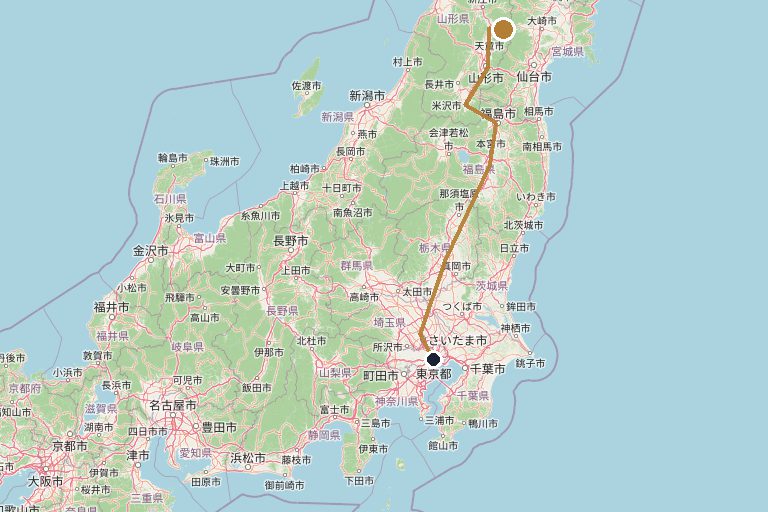
Tokyo Station
Yamagata Shinkansen “Tsubasa” · ~3 h 15 m · ¥14,430 reserved seat, regular season · covered by JR Pass For overseas visitors, the area-specific JR EAST PASS (Tohoku) also covers the route to Oishida: ¥35,000 for 5 days.
Oishida Station· small lockers only; ship luggage ahead
“Ginzan Hanagasa” bus · 36–43 min · ¥1,000 cash only 5 buses a day, timed to Tsubasa arrivals; miss yours and you wait hours
Ginzan Onsen· the gas-lamp street. Cars stop here; on foot only beyond this point.
Other starts: from Sendai, take the Senzan Line to Yamagata, a local train to Oishida, then the same bus (~3.5 h total, fare varies by train).
Trip Receipt per person · from Tokyo · 1 night
Shinkansen, round trip¥28,860
“Ginzan Hanagasa” bus, round trip¥2,000
Getting there~¥30,900
Inn (1 night, dinner & breakfast)¥30,000–50,000
Soba, curry bread & small change~¥3,000
The whole scene~¥64,000–84,000
This is the Budget badge at the top of the page, itemized. The village skews high; Ginzanso is the value pick. Checked August 2026.
Shinkansen fare is the regular-season reserved seat price and shifts ±¥340 or more by season. Access facts checked August 2026. Schedules change every season, so verify before you travel.
JR Pass
Partial. The shinkansen is covered; the bus from Oishida is not: ¥1,000 one way, cash only, no IC cards. JR East Tohoku Area Pass also works for the train.
Car
Not needed. The village itself is pedestrian-only, and winter mountain driving here is not worth the risk.
Luggage
Only small lockers at Oishida Station. Ship your bags ahead to your ryokan, or travel light.
Winter Notes
The bus runs 5 round trips a day, timed to Tsubasa arrivals, and if you miss yours you wait hours. Dec–Feb buses are likely to run late in heavy snow. Book your inn 2–3 months ahead.
The Honest Part
Most of what makes Ginzan worth the trip happens after dark, and that's hard to see for yourself on a day trip: the last bus out leaves not long after the lamps come on. We strongly recommend staying the night.
The Winter Evening Rule
Since the 2024–25 season, winter evenings are formally regulated. In winter 2025–26 (from Dec 20): daytime entry was free; 5–8 p.m. required a timed online ticket (around 100 people per hour, park-and-ride); and from 8 p.m. to 10 a.m. the village closed to everyone but overnight guests. The scheme is announced each autumn, so verify the current rules on the official site before planning an evening visit. Checked August 2026.
05 — Where to Stay
Four inns worth booking
Disclosure: some booking links below may earn us a commission at no extra cost to you. Inns are chosen on merit, never for commission. When the best inn has no bookable partner link, we link it anyway.
Price guide, per person with dinner & breakfast: $$ from around ¥20,000 · $$$ roughly ¥30,000–50,000 and up. Winter weekends run highest; solo travelers pay a premium. Treat as a planning range, not a quote.
Notoya Ryokan
$$$
Ryokan · founded 1892 · Registered Tangible Cultural Property
The building on every postcard of this street. Book a river-facing room and the postcard view is the one from your window, which is worth the booking hassle: reservations open months out and go fast.
English site availableWeb booking only: no phone, no OTAs
Fujiya
$$$
Ryokan · 8 rooms · rebuilt by architect Kengo Kuma
A century-old inn rebuilt by Kengo Kuma, with screens of fine bamboo, stained glass and washi light, plus five private baths you can use around the clock. Choose it if you'd rather have serious modern design inside than a period room; the old street is still right outside.
Ryokan · on the gas-lamp street · two source-fed indoor baths
The middle path: one of the tall wooden inns of the old street itself, at a friendlier price than its famous neighbors. Rooms are simpler than Notoya's, and the two small indoor baths run straight from the source, with the men's and women's sides swapping by time of day. Step out the front door and you're in the lamplight.
English: inquire aheadBook via the official site or Japanese travel sites
Ginzanso
$$
Modern ryokan · edge of the village · open-air baths
The practical choice: the village's largest inn, a few minutes' walk from the old street. Rooms are easier to get, staff are used to overseas guests, and the open-air baths face the snowy gorge. Rooms here are genuinely easy to get, at a friendly price.
Day-trippers arrive around noon and head home on the afternoon buses. The hours that belong only to overnight guests come twice: late at night after nine, and in the morning before the first bus arrives. In recent seasons the village has closed to non-guests from 8 p.m. to 10 a.m., which means the town spends fourteen hours a day belonging only to the people sleeping in it.
The first secret hour: past nine, the street empty, the river holding all the light. Only overnight guests see this. Photo by Shino Nakamura on Unsplash
Take the morning bath first, then walk the street to its end, past the last inn, where Shirogane Falls drops 22 meters into the gorge. The trail continues up toward the old silver mine tunnel that gave the town its name. It's about 15 minutes on foot in green seasons, but under heavy snow the upper path is often impassable. Ask your inn before climbing past the falls.
Time your exit around lunch, not before it: the village's soba shops open at about 11:00 and close by 13:30 (hand-ground local buckwheat, eaten in a wooden room over the river). Grab a warm curry bread from the little stand on the street for the bus ride. And if you want one last soak, Ginzanso and Kosekikan open their baths to non-guests between roughly 11:00 and 14:00. It's a good note to end the trip on.
Recommended Soba · Near Ginzan
Izu no Hana, the soba and sake house at the village entrance, has been feeding this street since 1952: soba at lunch, sake and small dishes in the evening (closed Wednesdays). Takimitei, the soba room at Takimikan on the rise near Shirogane Falls, serves juwari soba (100% buckwheat) milled from Obanazawa grain.
Recommended Soba · Near Oishida
Shichibei Soba, in the hill hamlet of Jinengo (a taxi ride from Oishida Station), has exactly one menu: all-you-can-eat ita-soba with a daikon-juice tsuyu, ¥1,500, 11:00 to 15:00, closed Thursdays. Soba Kiyo, on the Oishida soba road, mills whole buckwheat in-house for binder-free juwari soba; expect a queue on weekends. Hours checked August 2026. Country soba shops keep country hours, so confirm before you build lunch around one.
07 — Commissioned Review
One writer. Actually went. Paid to be honest.
Disclosure: This review was commissioned by SPECTRIP, the publisher of HYAKKEI. The writer traveled independently (their visit date is shown below) and was paid for their writing, not their opinion.
Writer: recruiting nowSeasoned Japan travelers only, with a night spent hereVisit date shown on publish
VerdictOne line. Did the scene earn its number? Answered after the visit.
The momentThe specific minute it moved them, and what the light was doing when it did.
Who shouldn't comeThe honest anti-recommendation. Every scene has one.
Expert Panel Score3 travel writers who have stayed here · recruiting now
Impact★★★★★—
Onlyness★★★★★—
Worth the Journey★★★★★—
Stay & Food★★★★★—
Return Intent★★★★★—
Average of 3 writers with published travel work, each of whom has spent a night here. Every panelist also writes a full review. The featured one appears above; the others will be readable here. Visit dates shown with each score. Panelists are paid for their judgment, never for a number.
08 — Make It a Trip
Pair it with another scene
2 Nights — Yamagata Deep Winter
Ginzan Onsen → Zao Snow Monsters
Spend the first night under the gas lamps, then move on to Zao Onsen and sleep beneath the frozen “snow monsters” of Scene No.2. Both hang off Yamagata Station, so they combine into one short loop. Scene No.2 is written and waiting.
From the Golden Route
Tokyo, 1 night round trip
The Yamagata Shinkansen makes this the easiest “beyond the Golden Route” trip you can take from the capital. Leave Tokyo at noon, be under the lamps by dusk.
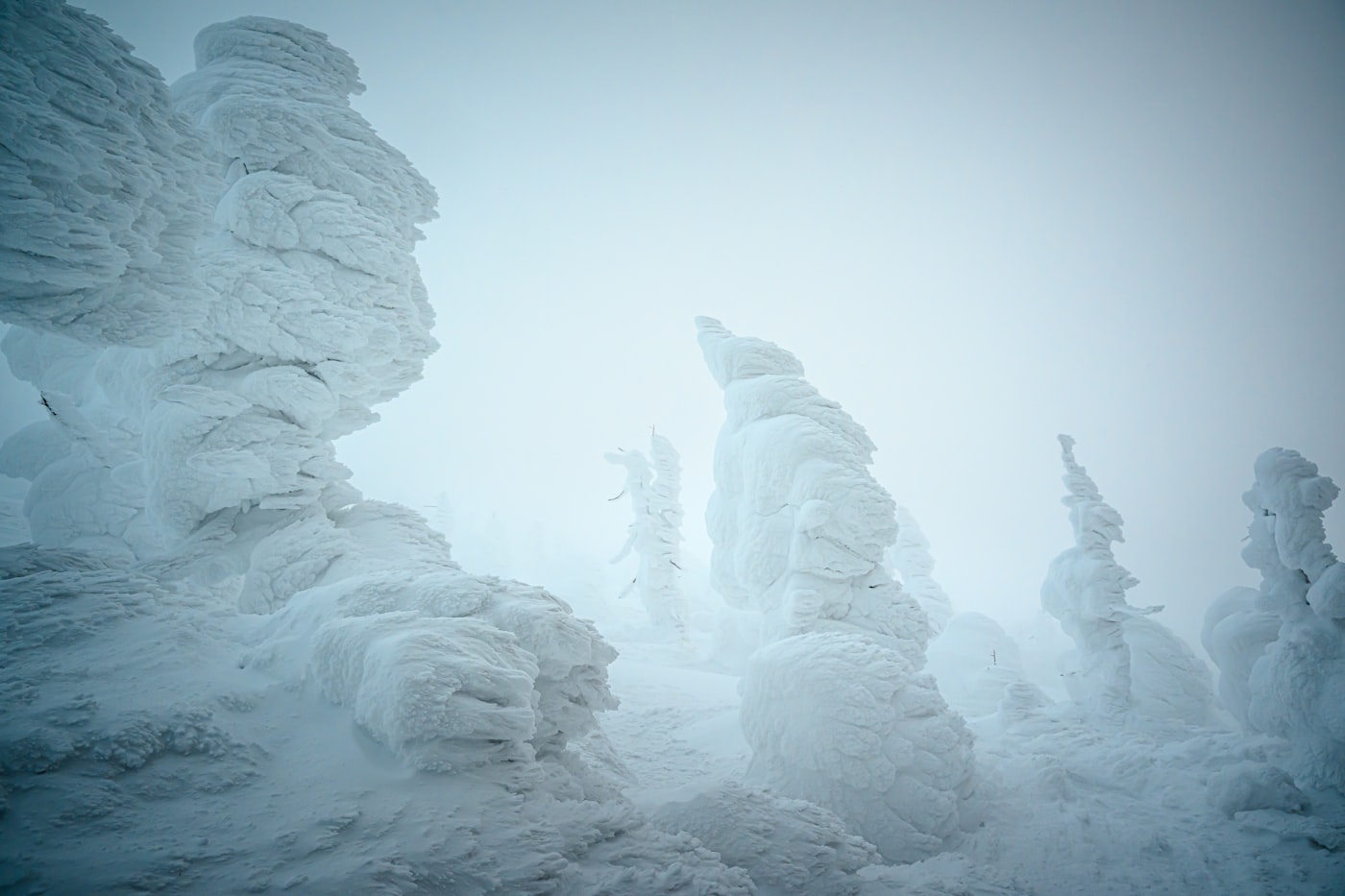
Two hours from Ginzan, the juhyo of Zao, Scene No.2, stand in the fog. Photo by pen_ash on Unsplash
09 — Good to Know
The questions you'd ask us over coffee
How much cash should I bring?
Treat the village as cash-first, and plan as if there is no usable ATM once you leave the shinkansen line. The bus is cash-only (¥1,000 each way), and day-use baths, soba lunches and street snacks often are too. Inns increasingly take cards, but don't build your plan on it.
Withdraw at a convenience-store ATM before boarding the bus. ¥10,000–20,000 per person on top of prepaid lodging is a comfortable margin for a one-night stay.
Can I see the lamps on a day trip?
In winter, mostly no. And now it's official. Recent winters have required a timed online ticket for the 5–8 p.m. window (roughly 100 people per hour, park-and-ride from outside the village), with the village closed to non-guests from 8 p.m. to 10 a.m. Tickets for weekends and holidays sell out early.
In practice, a day trip gets you a ticketed look at the first hour of lamplight, and only if you booked weeks ahead. Staying overnight is the only way to see the rest. Rules are re-announced each autumn; check the official Ginzan Onsen site for the current season.
Where do I eat dinner?
At your inn: book a plan with dinner and breakfast (2-shoku-tsuki). That's the normal way to stay here, and the kaiseki dinner is one of the main reasons to bother coming this far.
The village's restaurants are lunch businesses: kitchens open around 11:00 and close by 13:30–14:00. After dark there is no restaurant row and no convenience store. Arrive without a dinner plan and you will go to bed hungry.
What do the $ signs mean in Where to Stay?
Per person, per night, with dinner and breakfast: $$ from around ¥20,000 · $$$ roughly ¥30,000–50,000+. January weekends sit at the top of the range; solo travelers usually pay a premium. Ranges are a planning guide, checked August 2026; the booking page is the truth.
The Budget badge at the top of this page is the whole trip: per person, Tokyo round trip + one night with meals + local transport. For Ginzan that lands around ¥65,000–85,000, and the shinkansen is most of it.
How is the town laid out? Is there a map?
Simple: the bus stops at the village entrance, and from there the town is one pedestrian street along the river, walkable end to end in about ten minutes, finishing at Shirogane Falls. Your inn is somewhere on that street or just off it.
Taxis run from Oishida Station: about 20 minutes and roughly ¥5,300 for a standard cab. But cabs are few in snow country, so don't count on one waiting. Ask your inn to book, or arrange at the station rank when you arrive, and pad every winter connection.
What should I wear on my feet in January?
Waterproof boots with real tread. The street is packed snow and ice, watered by onsen steam. Slip-on micro-spikes are cheap insurance and pack flat. Skip the umbrella-and-sneakers approach: locals wear boots and a hooded coat, and in gas-lamp light you'll want both hands for the camera anyway.
10 — Traveler Voices
Been here? Tell the next traveler what the guidebooks won't.